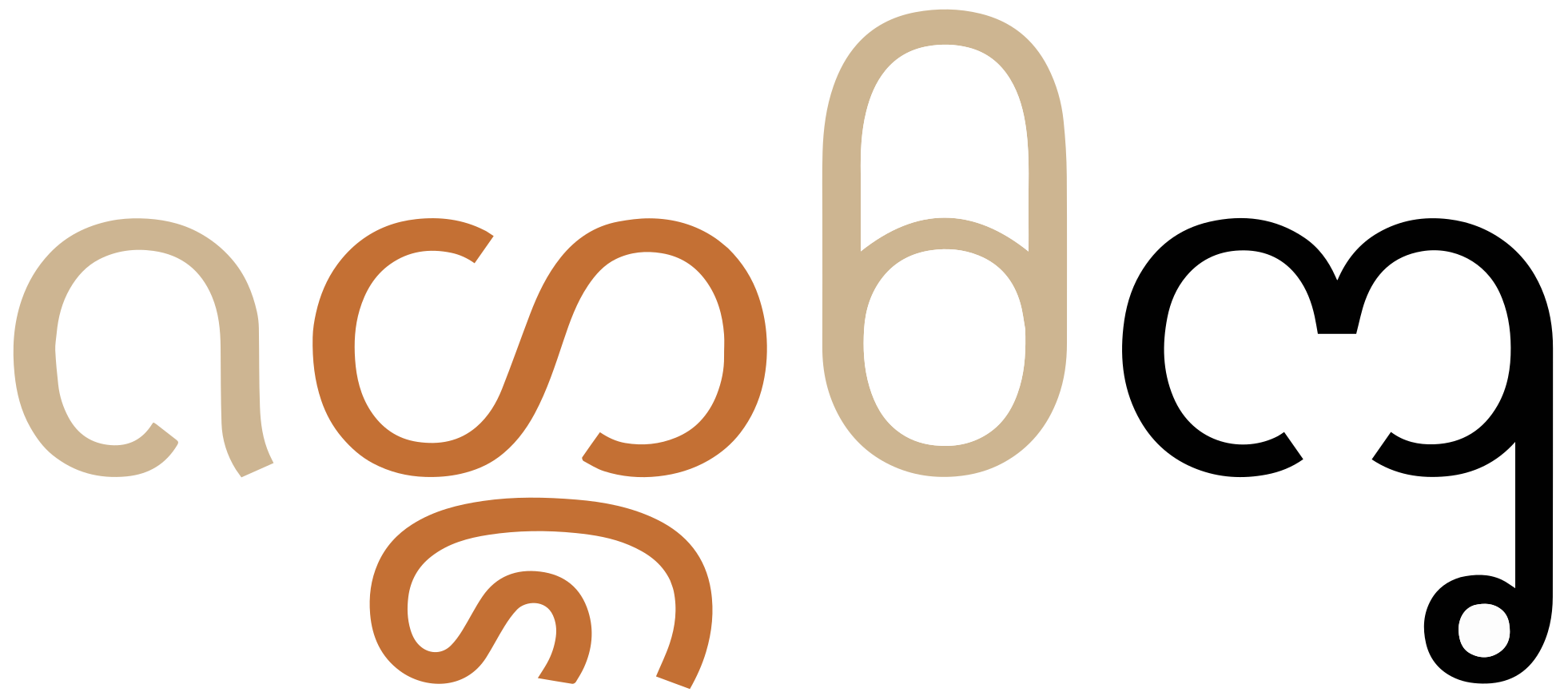
New Tai Lü vowels are all ordinary spacing letters, including pre-base vowels, which need to be inserted before the consonant in the text stream. However, some fonts incorrectly attempt to reorder those vowels for display. This includes Noto Sans New Tai Lue, and Dai Banna SIL Book/Light. Another SIL font, Nokyung, appears to render the text correctly.
This page brings together basic information about the New Tai Lü script and its use for the Tai Lü language. It aims to provide a brief, descriptive summary of the modern, printed orthography and typographic features, and to advise how to write Tai Lü using Unicode.
Dai Lue is spoken in the southern part of Yunnan, China, and in the surrounding countries by approximately 554,600 people.Webonary§https://www.webonary.org/
The New Tai Lue script is a simplified version of the Tai Tham (Lanna) script, created in the 1950s, and mainly used by the Tai Lü people of Southern China for writing the Lü language. In 1987 the Old Tai Lü script was revived and widely used. However, the Chinese government once again promoted use of the New Tai Lü script in 1997, with the result that both scripts are currently in use in China.
The script is also known as Xishuangbanna Dai or Simplified Tai Tham ( ᧑᧒ᦗᧃᦓᦱ ).
Although it is used for shop and street signs in some areas, few people can read the script.
Unicode 17 has 1 dedicated Tai Lü block, comprising 83 characters.
The Tai Lü script is an abugida, ie. each consonant contains an inherent vowel sound.
The orthography is syllable-based, and the language tonal.
One distinguishing feature of New Tai Lü is its regularity, and its simplicity compared to Tai Tham, which can also be used for the Tai Lü language. Many of the glyphs resemble Tai Tham, but they are also simplified, commonly combining into a single code point what would be multiple characters in Tai Tham. For example, ᦦ, ᦜ, and ᦗ.
Unlike many other SE Asian scripts, New Tai Lü uses a visual encoding model, so vowel signs that appear before the base must also be typed and stored before the base (see prebase).
There are 4 pre-base letters but no circumgraphs. However, this page lists 9 composite vowel signs (made from 8 components), where in 6 cases vowel letters both precede and follow a base consonant. Composite vowel signs can involve up to 3 glyphs, and can surround the base consonant(s) on up to 2 sides (left and right only).
Standalone vowel sounds are written after one of the 2 glottal stop consonant letters (IPA transcriptions include the glottal stop). All vowels are preceded by a consonant.
Tone is also marked by spacing characters, and only after unchecked syllables. There are 6 tones, which are marked by the onset class, the type of syllable, and where needed one of 2 tone marks.
Consonants Tai Lü has 44 basic consonant letters. Each basic consonant is one of a pair, denoting either a high or low tonal register for the same phonetic sound. This is very regular — each sound is represented by 2 consonant letters. Tone is indicated by a combination of the consonant class and tone marks.
Vowel absenceVowel absence is indicated using special letters only. There are no conjunct forms and no vowel killer character. Some clusters in Tai Tham are represented as single characters in New Tai Lü, in particular high tone variants such as ᦜ and ᦖ (ᩉᩖ and ᩉ᩠ᨾ in Tai Tham).
Medial consonant sounds are written using 6 dedicated letters that represent 3 pairs of onset consonant cluster sounds. There are no medial consonant letters.
Syllable codas use 7 dedicated letters, which cover all needs.
Numbers Tai Lü has a set of native digits, derived from the Tai Tham hora set.
Layout New Tai Lü text runs left to right in horizontal lines. Words are separated by spaces. There is no case distinction.
Punctuation uses a mixture of ASCII and fullwidth punctuation.
Notable features
vowels are visually encoded.
no combining marks.
very regular division of consonant into high and low registers
tone depends on combinations of consonant register, syllable type, & tone marks.
These are sounds for the Tai Lü language. For more details, see the Phonology pages of the SIL Dai Lue Dictionary§https://www.webonary.org/dailu/language/phonology/?lang=en
Click on the sounds to reveal locations in this document where they are mentioned.
Phones in a lighter colour are non-native or allophones. Source Wikipedia.
Vowel sounds
Plain vowels
Diphthongs
Vowels in open syllables are long, whereas ones in closed syllables are short, except for aː and uː.
All diphthongs are plain vowels followed by i̯.
Consonant sounds
labial
alveolar
post-
alveolar
palatal
velar
glottal
stops
pb
td
kkʷ
ʔ
aspirated
pʰ
tʰ
affricates
t͡s
t͡ɕ
fricatives
fv
ssʷ
ɕ
xxʷ
h
nasals
m
n
ŋ
approximants
w
l
j
Initials t͡s and s are palatalised before front vowels i, e, ɛ, and become t͡ɕ and ɕ, respectively. For example, t͡síŋhard and si᷄pten are pronounced as t͡ɕiŋ˥ and ɕip˧˥, respectively.
Finals
labial
alveolar
post-
alveolar
palatal
velar
glottal
stop
p
t
k
ʔ
nasal
m
n
ŋ
approximant
w
j
Tones
Tai Lü has 2 tones in checked syllables, and 6 tones in unchecked syllables. See tones.ws
Structure
The script is syllable-based.
Syllables. A syllable's phonetic structure is C(ʷ)(V)(C) (unchecked) or C(ʷ)(V)C (checked). Unchecked syllables end with a vowel or one of the sonorants m, n, ŋ, w, j. Checked syllables end with one of ʔ, p, t, k.
The onset consonant sequence may be one of kʷ, xʷ, sʷ.
Tai Lü has 6 tones in unchecked syllables. In checked syllables there are two tones.ws
The characters used to represent the phonetics follow the model
(pV) C (V) (VS) (Fs|Fp) (T)
where: pV is a pre-base vowel, VS is the vowel shortener ᦰ, Fs is one of the set of final sonorants, Fp is one of the set of final plosives, and T is a tone marker.
There are no medial consonant letters. Single characters are available for the onset sequences.
An onset consonant may represent a high or low register. Every consonant sound is represented by a pair of letters.
Syllable-final consonants are one of a small set of dedicated letters.
There are two tone marks, which combine with the register of the onset consonant to determine one of the 6 tone values.
Words. Many words are single syllables, but also many are composed of multiple syllables. Multi-syllabic words may have one or more 'minor' syllables, which have the form CV and can only have one of the following short vowels: a, i, or u. All CV syllables in the following examples are minor syllables.SIL Dai Lue Dictionary§https://www.webonary.org/dailu/language/phonology/?lang=en
eg.
ᦔᦞᦎᦲᦰ
ᦉᦳᦟᦱ
ᦗᧃᦒᦓᧂ
There are also many compound words. The following words are, respectively, compounds of thing:eat, and word:think.SIL Dai Lue Dictionary§https://www.webonary.org/dailu/language/phonology/?lang=en
eg.
ᦃᦸᧂᦂᦲᧃ
ᦅᧄᦅᦹᧆ
Vowels
Simple
-ᦲ-,-ᦲᦰ,-ᦲ, ,-ᦹ-,-ᦹᦰ,-ᦹ, ,-ᦳ,-ᦴ
ᦵ--,ᦵ-ᦰ,ᦵ-, ,ᦵ-ᦲ-,ᦵ-ᦲᦰ,ᦵ-ᦲ, ,ᦷ--,ᦷ-ᦰ,ᦷ-
ᦶ–-,ᦶ–ᦰ,ᦶ–, ,-ᦸ-,-ᦸᦰ,-ᦸ
ⓘ,-ᦰ,-ᦱ
Diphthongs
ᦿ, ,ᦼ
ᦽ
ᧀ
᧟, ,ᦵ-ᧀ, ,ᦾ
ᦺ,ᦻ
ⓘ represents the inherent vowel. Consonant locations are indicated by -.
Inherent vowel
ᦂ
kaU+1982 NEW TAI LUE LETTER HIGH KA
The inherent vowel for Tai Lü is pronounced a. So sa and va in the following word are written by simply using the consonant letter.
eg.
ᦉᦛᧃ
ᦉ,ᦛ,ᧃ
The inherent vowel is not usually pronounced at the end of a word.
Since Tai Lü consonants normally include an inherent vowel, the orthography has ways to indicate a consonant that is not followed by a vowel sound. See novowel.
Post-consonant vowels
The New Tai Lü orthography represents non-inherent vowels using 17 ordinary letters (no combining marks). Unlike many other SE Asian scripts, New Tai Lü uses a visual encoding model, so vowel signs that appear before the base must also be typed and stored before the base (see prebase).
There are 4 pre-base letters but no circumgraphs. However, this page lists 9 composite vowel signs (made from 8 vowel signs), where in 6 cases vowel letters both precede and follow a base consonant. Composites can involve up to 3 glyphs, and can surround the base consonant(s) on up to 2 sides (left and right only).
Basic vowels
ᦂᦲ
ki
Vowel letters are pronounced short in closed syllables, and long in open syllables. The exceptions are u and a, which have distinct letters for long and short variants.ws Short open syllables are written using ᦰ after the vowel letter(s).
The simple New Tai Lü vowels are written as follows. All sounds are represented using one or more letters (see also compositeV). There are no combining marks.
ᦲ,ᦲᦰ,ᦹ,ᦹᦰ,ᦳ,ᦴ,ᦵ,ᦵ◌ᦰ,ᦵ◌ᦲ,ᦵ◌ᦲᦰ,ᦷ,ᦷ◌ᦰ,ᦶ,ᦶ◌ᦰ,ᦸ,ᦸᦰ,ᦰ,ᦱ
eg.
ᦉᦲᧇᦉᦸᧂ
ᦔᦞᦎᦲᦰ
ᦇᦹᧃᦵᦙᧆ
ᦶᦓᦰᦓᧄ
The typical use of ᦰ is to produce a short open a vowel, however it is also used to indicate shortness for the vowel sign combinations, in which case it represents just the glottal stop. It is also sometimes used to distinguish homonyms or for onomatopoeia.ws
eg.
ᦂᦰᦡᦱᧆ
ᦒᦰᦵᦟ
Observation: Wiktionary has the word ᦶᦟᧂᦰ, where the ᦰ appears after the coda. Is this normal?
Diphthongs
ᦂᦿ
kɯi̯
Seven single character vowel signs represent diphthongs that combine the basic vowel sound with i̯. Another diphthong is represented using a composite vowel sign.
ᦿ,ᦼ,ᦵ◌ᧀ,ᦽ,ᧀ,ᦾ,ᦺ◌,ᦻ
Standalone vowels
All vowels are preceded by a consonant. What may be standalone vowels in other related languages are written after one of the 2 glottal stop consonant letters, ᦀ and ᦁ, and IPA transcriptions include a glottal stop.
eg.
ᦀᦱᧇ
ᦶᦀᧅ
ᦵᦁᦲᧁᧈᦵᦋᦲᧁᧈ
Vowel composition
This section describes various vowel components and behaviours associated with this orthography.
Pre-base vowel signs
ᦷᦂ
koː
Four vowel signs appear to the left of the base consonant letter or cluster.
ᦵ◌,ᦷ◌,ᦶ◌, ,ᦺ◌
Because New Tai Lü uses a fully visual encoding model (since Unicode 8.0)u, the 4 vowel signs that appear to the left of the consonant are typed and stored before the consonant, even though they are pronounced after.
A pre-base vowel sign. The vowel letter is typed and stored before the consonant after which it is pronounced.details
ᦒᦰᦵᦟ
show composition
ᦒᦰᦵᦟ
ᦶ should not be typed as two successive ᦵ characters.u
Composite vowel signs
ᦵᦂᦲᦰ
koː
All vowels represented by combinations of the above characters. Most, but not all, of these involve the use of the vowel-shortening letter, ᦰ.
-ᦲᦰ,-ᦹᦰ,ᦵ-ᦰ,ᦵ-ᦲᦰ,ᦵ-ᦲ,ᦷ-ᦰ,ᦶ-ᦰ,-ᦸᦰ, ,ᦵ-ᧀA composite, made of 2 ordinary letters, which appear on opposite sides of the base. The first vowel letter is typed and stored before the base consonant.show composition
ᦵᦄᦲᧅ
Characters that don't appear in the combinations:
ᦱ,ᦳ,ᦴ,ᦺ,ᦻ,ᦼ,ᦽ,ᦾ,ᦿShow which combinations contain a given character:
ᦲ
-ᦲᦰ,ᦵ-ᦲᦰ,ᦵ-ᦲ
ᦹ
-ᦹᦰ
ᦸ
-ᦸᦰ
ᦰ
-ᦲᦰ,-ᦹᦰ,ᦵ-ᦰ,ᦵ-ᦲᦰ,ᦷ-ᦰ,ᦶ-ᦰ,-ᦸᦰ
ᦵ
ᦵ-ᦰ,ᦵ-ᦲᦰ,ᦵ-ᦲ,ᦵ-ᧀ
ᦷ
ᦷ-ᦰ
ᦶ
ᦶ-ᦰ
ᧀ
ᦵ-ᧀ
Show details about glyph positioning
The following list summarises where vowel signs are positioned around a base consonant to produce vowels, and how many instances of that pattern there are. Numbers after the + sign represent combinations of vowel signs.
4 pre-base, eg. ᦵᦂe͕k (ke)
13 post-base, eg. ᦂᦱkā
+3 post+post-base, eg. ᦂᦲᦰkiʔ
+4 pre+post-base, eg. ᦵᦂᦲe͕ki (ke͕i)
+1 pre+post+post-base, eg. ᦵᦂᦲᦰe͕kiʔ (ke͕iʔ)
Vowel-signs only appear to the left and/or right of a consonant.
Tones
New Tai Lü has two tone marks, which are written at the end of an unchecked syllable. Because consonants come in pairs to denote two tonal registers, the two tone marks allow for representation of six specific tones.ws
The tone marks are ordinary spacing characters.
ᧈ,ᧉ
Tai Lü has 2 tones in checked syllables, and 6 tones in unchecked syllables.ws
Register
Checked?
Mark
Description
Example
High
checked
-
˧˥high-rising
ᦜᧅ
ᦜᦱᧅ
unchecked
-
˥high
ᦂᦱ
ᧈ
˧˥high-rising
ᦂᦱᧈ
ᧉ
˩˧low-rising
ᦂᦱᧉ
Low
checked
-
˧mid
ᦟᧅ
ᦟᦱᧅ
unchecked
-
˥˩falling
ᦅᦱ
ᧈ
˧mid
ᦅᦱᧈ
ᧉ
˩low
ᦅᦱᧉ
Vowel sounds mapped to characters
This section maps Tai Lü vowel sounds to common graphemes in the New Tai Lü orthography.
The left column shows closed syllables, and the right open.
Plain vowels
i~iː
mixedᦲ
iʔ
openᦲᦰ
ɯ~ɯː
mixedᦹ
ɯʔ
openᦹᦰ
u
closedᦳ
uː
openᦴ
e~eː
mixedᦵ
eʔ
openᦵ-ᦰ
ɤ~ɤː
mixedᦵ-ᦲ
ɤʔ
openᦵ-ᦲᦰ
o~oː
mixedᦷ
oʔ
openᦷ-ᦰ
ɛ~ɛː
mixedᦶ
ɛʔ
openᦶ-ᦰ
ɔ~ɔː
mixedᦸ
ɔʔ
openᦸᦰ
a~aː
inherent voweleg. ᦅᧄ
closedᦰ
mixedᦱ
Diphthongs
ɯi̯
ᦿ
ui̯
ᦼ
ɤi̯
ᦵ-ᧀ
oi̯
ᦽ
ɔi̯
ᦾ
əi̯
ᧀ
ai̯
ᦺ
aːi̯
ᦻ
Vowel absence
Vowel absence principally occurs either when a consonant is a syllable coda, or when a consonant is part of a consonant cluster.
Dedicated code points are used for syllable codas, both word-medially and word-finally, to show that there is no following inherent vowel (see finals). This also eliminates potential confusion about syllable boundaries. There is no virama, and no conjuncts.
eg.
ᦗᧃᦒᦓᧂ
ᦗ,ᧃ,ᦒ,ᦓ,ᧂ
Onset consonants can be labialised, but there are also distinct code points for that (see onsets).
eg.
ᦦᦱᧂ
ᦦ,ᦱ,ᧂ
Consonants
High tonal register
Low tonal register
Initials
ᦔ,ᦢ,ᦎ,ᦡ,ᦂ,ᦦ,ᦀ
ᦗ,ᦥ,ᦑ,ᦤ,ᦅ,ᦨ,ᦁ
ᦕ,ᦏ
ᦘ,ᦒ
ᦈ,ᦈ
ᦋ,ᦋ
ᦚ,ᦛ,ᦉ,ᦪ,ᦃ,ᦧ,ᦠ
ᦞ,ᦝ,ᦌ,ᦫ,ᦆ,ᦩ,ᦣ
ᦖ,ᦐ,ᦄ
ᦙ,ᦓ,ᦇ
ᦜ,ᦊ
ᦞ,ᦟ,ᦍ
Ligatures
᧞
᧟
Finals
ᧇ,ᧆ,ᧅ
ᧄ,ᧃ,ᧂ
ᧁ
Basic consonants
Basic consonant sounds in Tai Lü are written using the following letters. For each sound there are two letters, one used for the high tonal register, and the other for the low register. There are no irregularities. Tone is indicated by a combination of the consonant class and tone marks (see tones).ws
Click on each letter for more details and for examples of usage, especially where more than one sound is indicated.
High class consonants
ᦔ,ᦕ,ᦢ,ᦎ,ᦏ,ᦡ,ᦂ,ᦦ,ᦀ,ᦈ,ᦚ,ᦉ,ᦪ,ᦃ,ᦧ,ᦠ,ᦖ,ᦐ,ᦄ,ᦛ,ᦜ,ᦊ
Low class consonants
ᦗ,ᦘ,ᦥ,ᦑ,ᦒ,ᦤ,ᦅ,ᦨ,ᦁ,ᦋ,ᦝ,ᦌ,ᦫ,ᦆ,ᦩ,ᦣ,ᦙ,ᦓ,ᦇ,ᦞ,ᦟ,ᦍ
The following examples illustrate how the choice of consonant affects the tone of the syllable. For more information, see tones.
cf.
ᦜᧅ
ᦟᧅ
cf.
ᦅᦱᧈ
ᦂᦱᧈ
Onsets
There are no onset clusters, per se, but 6 onsets (3 pairs of sounds) can be labialised. Dedicated letters are used for this. There are no medial consonant letters.
ᦦ,ᦨ,ᦪ,ᦫ,ᦧ,ᦩ
eg.
ᦦᦱᧂ
ᦋᦲᧉᦩᦱᧈ
Codas
New Tai Lü has a set of dedicated syllable-final consonants. A small hook-like modification indicates that they have no inherent vowel.u
ᧇ,ᧆ,ᧅ,ᧄ,ᧃ,ᧂ,ᧁ
eg.
ᦅᦹᧆ
ᦆᧄᦃᦱᧁ
ᦏᧄᧉ
The use of such dedicated coda letters removes potential ambiguities about where syllable boundaries fall.
Consonant to script mapping
This section maps Tai Lü consonant sounds to common graphemes in the New Tai Lü orthography.
The left-hand column shows high register consonants, the middle column has low register consonants, and the right-hand column shows syllable-final consonants
p
highᦔ
lowᦗ
codaᧇ
pʰ
highᦕ
lowᦘ
b
highᦢ
lowᦥ
t
highᦎ
lowᦑ
codaᧆ
tʰ
highᦏ
lowᦒ
t͡s
highᦈ
lowᦋ
t͡ɕ
highᦈ
lowᦋ
d
highᦡ
lowᦤ
k
highᦂ
lowᦅ
codaᧅ
kʷ
highᦦ
lowᦨ
ʔ
highᦀ
lowᦁ
closedᦰ
f
highᦚ
lowᦝ
v
highᦛ
lowᦞ
s
highᦉ
lowᦌ
sʷ
highᦪ
lowᦫ
ɕ
highᦉ
lowᦌ
x
highᦃ
lowᦆ
xʷ
highᦧ
lowᦩ
h
highᦠ
lowᦣ
m
highᦖ
lowᦙ
codaᧄ
n
highᦐ
lowᦓ
codaᧃ
ŋ
highᦄ
lowᦇ
codaᧂ
u̯
codaᧁ
l
highᦜ
lowᦟ
lɛʔ
ligature᧞
lɛu
ligature᧟
j
highᦊ
lowᦍ
Symbols
New Tai Lü has two ligatures, used for abbreviations. See abbrev.
᧞,᧟
Numbers
New Tai Lü has its own set of digits, derived from the Tai Tham hora set.u
᧐,᧑,᧚,᧒,᧓,᧔,᧕,᧖,᧗,᧘,᧙
᧚ is an alternative glyph for ᧑ when it might otherwise be confused with the vowel ᦱ.u
Text direction
New Tai Lü text runs left to right in horizontal lines.
Tai Lü letters don't interact, so no special shaping is needed.
And there are no combining mark, so context-based positioning of glyphs is also not necessary.
Typographic units
Word boundaries
Words are generally separated by spaces. However, in some texts spaces delimit phrases, rather than words.
Graphemes
Grapheme clusters
tbd
Since all New Tai Lü characters are spacing characters, they are all separate Unicode grapheme clusters. This means that, by default, operations such as forwards/backwards deletion, cursor movement & selection, and character counts all apply to individual characters, regardless of type or of syllabic context.
Punctuation & inline features
Phrase & section boundaries
In this orthography, Tai Lü appears to use a mixture of ASCII and fullwidth punctuation.
Observation: The Lü translation of the text in the SIL Tai Lü dictionary uses both ASCII and fullwidth commas in the same text. It also contains ASII full stops and an ASCII exclamation mark. See Dai Lue Dictionary§https://www.webonary.org/dailu/overview/introduction/?lang=lu.
Observation: New Tai Lü may include the following (needs to be checked).
!,?,:,;,。,、,,,.
Bracketed text
Observation: The Lü translation of the text in the SIL Tai Lü dictionary uses both ASCII parentheses. See Dai Lue Dictionary§https://www.webonary.org/dailu/overview/introduction/?lang=lu.
Observation: New Tai Lü may also use fullwidth Chinese punctuation, and therefore may include the following (needs to be checked).
〈,〉,《,》,(,)
Abbreviation, ellipsis & repetition
New Tai Lü has two ligatures, used for abbreviations.
᧞ represents the conjunction and.ws The long form is: